Manufacturing Technology: Concepts, Evolution, Processes, and Future Trends
1. Introduction to Manufacturing Technology
Manufacturing technology refers to the use of tools, machinery, processes, and systems to convert raw materials into finished or semi-finished products. It is one of the most important pillars of industrial development and economic growth. From simple hand tools used in ancient civilizations to today’s highly automated smart factories, manufacturing technology has continuously evolved to improve efficiency, quality, precision, and productivity.
In modern society, almost every product we use—such as smartphones, automobiles, medical devices, household appliances, and clothing—is the result of manufacturing technology. This field combines principles from mechanical engineering, electrical engineering, materials science, computer science, and management to design and optimize production systems.
Manufacturing technology not only focuses on how products are made but also emphasizes cost reduction, waste minimization, energy efficiency, safety, and sustainability. As global competition increases, manufacturers rely heavily on advanced technologies to remain competitive in international markets.
2. Historical Evolution of Manufacturing Technology
2.1 Early Manufacturing Systems
The earliest form of manufacturing dates back to prehistoric times when humans used stone tools to shape wood, bone, and animal skins. These early manufacturing activities were manual and relied entirely on human skill and physical effort.
Ancient civilizations such as Mesopotamia, Egypt, Indus Valley, and China made significant contributions to manufacturing. They developed techniques like pottery, metal casting, textile weaving, and brick making. The invention of the wheel, plow, and simple machines greatly improved productivity.
2.2 The Craft Production Era
During the Middle Ages, manufacturing was dominated by craft production, where skilled artisans produced goods by hand. Each product was unique, and quality depended heavily on the craftsman’s expertise. Although craft production allowed customization, it was slow, expensive, and unsuitable for mass demand.
2.3 The Industrial Revolution
The Industrial Revolution (18th–19th century) marked a turning point in manufacturing technology. The introduction of steam power, mechanized looms, and machine tools transformed production methods.
Key developments included:
-
Use of steam engines
-
Introduction of factories
-
Division of labor
-
Mechanized textile production
This period laid the foundation for mass production and modern manufacturing systems.
2.4 Mass Production and Automation
In the 20th century, manufacturing technology advanced rapidly with the introduction of electricity, assembly lines, and automation. Henry Ford’s moving assembly line revolutionized automobile manufacturing by reducing production time and cost.
Later developments included:
-
Numerical Control (NC) machines
-
Computer Numerical Control (CNC)
-
Industrial robots
-
Automated material handling systems
2.5 Digital and Smart Manufacturing
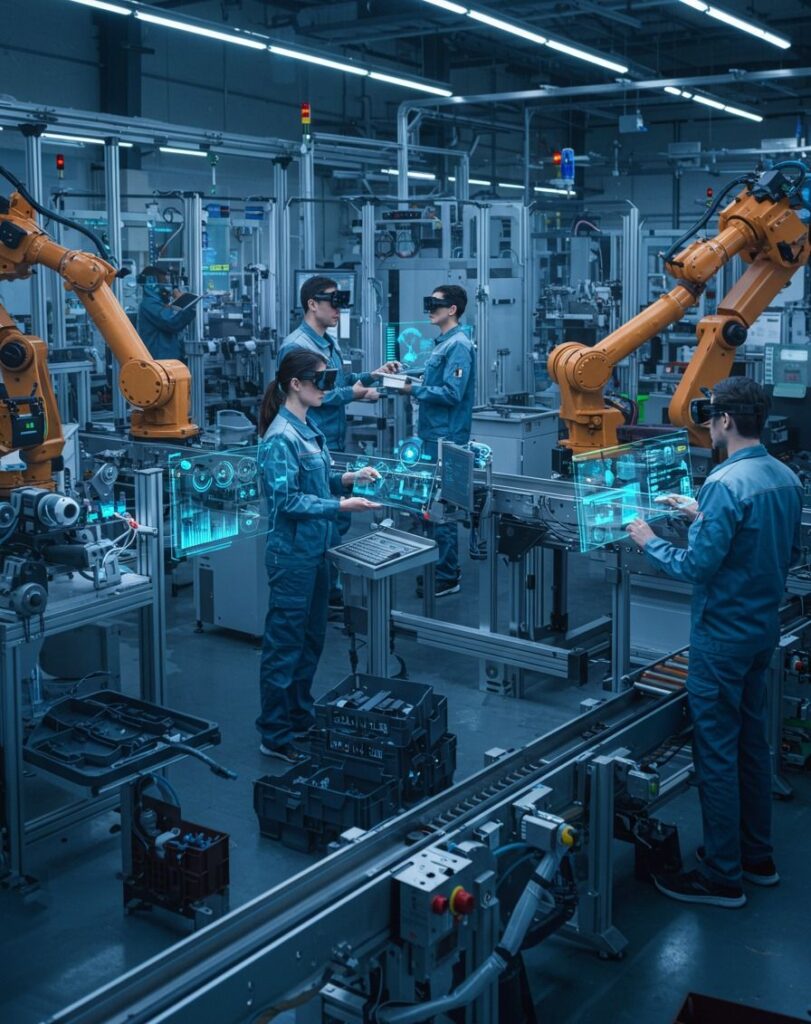
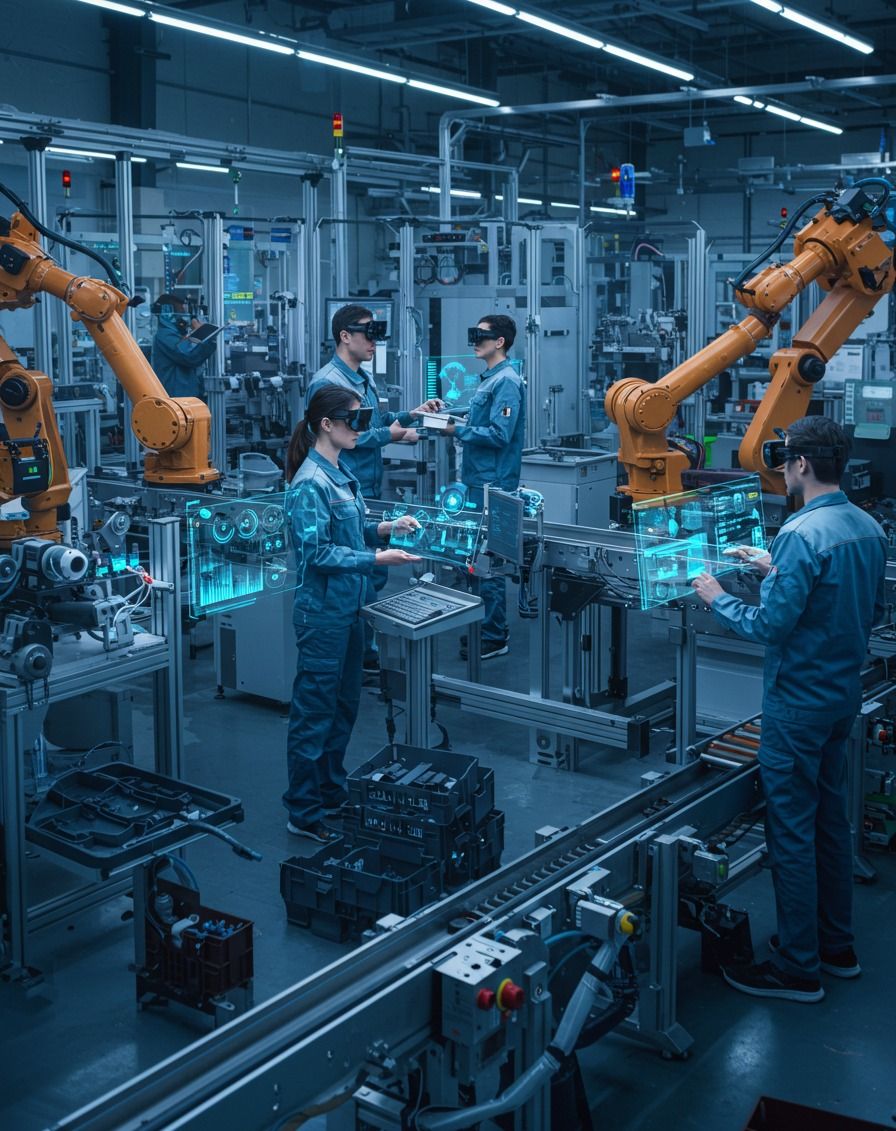
In the 21st century, manufacturing has entered the era of digital transformation. Technologies such as Artificial Intelligence (AI), Internet of Things (IoT), Big Data, and cloud computing are reshaping factories into smart, interconnected systems known as Industry 4.0.
3. Classification of Manufacturing Technology
Manufacturing technology can be broadly classified based on production methods, level of automation, and type of process.
3.1 Based on Production Volume
a) Job Production
-
Low volume, high variety
-
Customized products
-
Requires skilled labor
-
Examples: custom furniture, tool rooms
b) Batch Production
-
Medium volume, medium variety
-
Products made in batches
-
Examples: pharmaceuticals, garments
c) Mass Production
-
High volume, low variety
-
Standardized products
-
Examples: automobiles, electronics
d) Continuous Production
-
Very high volume
-
Continuous flow of materials
-
Examples: oil refining, cement plants
4. Manufacturing Processes
Manufacturing processes are the methods used to transform raw materials into finished products. These processes are selected based on material type, product design, cost, and required quality.
4.1 Casting Processes
Casting involves pouring molten material into a mold where it solidifies into a desired shape.
Common casting methods include:
-
Sand casting
-
Die casting
-
Investment casting
-
Centrifugal casting
Casting is widely used for producing complex shapes that are difficult or expensive to machine.
4.2 Forming Processes
Forming processes shape materials through plastic deformation without removing material.
Examples include:
-
Forging
-
Rolling
-
Extrusion
-
Drawing
These processes improve mechanical properties such as strength and toughness.
4.3 Machining Processes
Machining removes material to achieve precise dimensions and surface finish.
Common machining operations:
-
Turning
-
Milling
-
Drilling
-
Grinding
Advanced machining techniques include CNC machining, laser cutting, and electrical discharge machining (EDM).
4.4 Joining Processes
Joining processes combine two or more parts to form a single component.
Common joining methods:
-
Welding
-
Brazing
-
Soldering
-
Mechanical fastening
5. Role of Materials in Manufacturing Technology
Materials selection plays a crucial role in manufacturing. The performance, durability, and cost of a product depend heavily on the materials used.
5.1 Metallic Materials
-
Steel
-
Aluminum
-
Copper
-
Titanium
5.2 Non-Metallic Materials
-
Plastics
-
Ceramics
-
Glass
-
Rubber
5.3 Composite Materials
-
Fiber-reinforced plastics
-
Carbon fiber composites
Advanced materials enable lightweight, high-strength, and corrosion-resistant products.
6. Automation in Manufacturing
Automation involves the use of machines and control systems to perform tasks with minimal human intervention.
6.1 Types of Automation
-
Fixed automation
-
Programmable automation
-
Flexible automation
6.2 Benefits of Automation
-
Increased productivity
-
Improved quality
-
Reduced labor cost
-
Enhanced safety
6.3 Industrial Robots
Industrial robots are widely used in:
-
Welding
-
Painting
-
Assembly
-
Material handling
7. Computer-Aided Manufacturing (CAM)
Computer-Aided Manufacturing integrates computer systems with manufacturing processes.
Key components include:
-
CAD (Computer-Aided Design)
-
CAM software
-
CNC machines
CAM improves accuracy, reduces lead time, and enhances flexibility.
8. Importance of Manufacturing Technology
Manufacturing technology is essential for:
-
Economic development
-
Employment generation
-
Innovation
-
Global competitiveness
Countries with strong manufacturing sectors tend to have stable economies and higher living standards.
9. Challenges in Manufacturing Technology
Despite its advantages, manufacturing technology faces several challenges:
-
High initial investment
-
Skilled labor shortage
-
Cybersecurity risks
-
Environmental concerns
-
Rapid technological change
10. Conclusion
Manufacturing technology has evolved from simple manual techniques to highly automated and intelligent systems. It plays a vital role in shaping modern industries and economies. Understanding its processes, materials, and systems is essential for engineers, entrepreneurs, and policymakers.