.Laser Land Leveling Technology
The agricultural sector uses laser land leveling technology as a precise method for creating level agricultural fields through laser-based equipment. The conventional methods of land leveling require operators to assess land conditions through their eyesight which leads to uneven land assessment because of their unsteady manual methods. The process of laser land leveling develops entirely uniform field surfaces which results in better water management and improved soil conditions and higher agricultural production. The agricultural industry requires laser land leveling as necessary equipment because water resources become more restricted and sustainable farming methods gain importance.
Concept and Principle of Laser Land Leveling
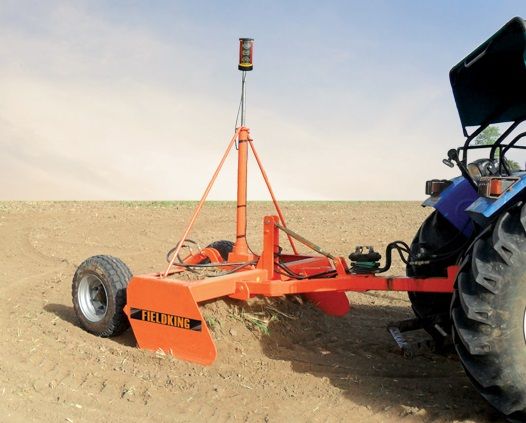
The basic principle of laser land leveling is to use a laser beam as a fixed reference plane to guide land shaping. The laser transmitter creates a continuous rotating laser beam which moves throughout the field to set an unchanging reference point. The system uses a leveling bucket or scraper to mount a laser receiver which detects the beam. The receiver transmits signals to the control system when the tractor moves over uneven terrain which triggers automatic adjustments to the scraper blade height. The system uses real-time adjustments to create a designated area for soil removal between higher ground and lower ground which results in an even distribution of soil across the area.
Components of a Laser Land Leveling System
Laser land leveling achieves a precision level of ±2 centimeters which exceeds the accuracy of traditional leveling methods. The precision level of this process becomes vital to achieve consistent irrigation results throughout flood-irrigated agricultural fields.
-
Laser Transmitter
The transmitter is placed on a stable tripod at a central location in the field. It emits a rotating laser beam and sets the desired slope or level. Advanced transmitters can be programmed for single or dual slopes, making them suitable for different field conditions. -
Laser Receiver
Mounted on a mast attached to the scraper, the receiver detects the laser beam. It determines whether the scraper is above or below the reference level. -
Control Box
The control box processes signals from the receiver and sends commands to the hydraulic system of the tractor. It automatically adjusts the height of the scraper blade without operator intervention. -
Scraper or Leveling Bucket
This attachment cuts soil from higher spots and fills lower spots. It plays a direct role in shaping the field surface. -
Tractor and Hydraulic System
A suitable tractor provides the power and hydraulic control needed to operate the leveling equipment effectively.
Types of Laser Land Leveling
Laser land leveling systems divide into two main categories which depend on specific field needs and their corresponding slope requirements.
Single-Slope Laser Leveling: Used where water needs to flow in one direction, such as surface drainage fields.
Dual-Slope Laser Leveling: The system enables water to flow in two different directions which enhances the drainage capacity of extensive agricultural fields.
Flat Leveling: This technique serves flood irrigation operations for rice farming because it provides constant water distribution throughout the fields.
The various types of agricultural equipment which exist provide solutions to different farming requirements while they boost the effectiveness of water distribution systems.
Advantages of Laser Land Leveling
Efficient Water Management
Laser land leveling provides its most important benefit through enhanced water usage efficiency. The uniform design of fields enables water distribution during irrigation which results in decreased water runoff and deep soil water loss. Farmers typically save 20 through 30 percent of their irrigation water usage which becomes essential for areas that experience water shortages.
Increased Crop Yield and Quality
Farmers use uniform land leveling methods because these methods create equal seed distances which lead to better seed germination and nutrient spread throughout the field. The uniform growth of crops results in simultaneous maturation which produces both higher yields and superior quality harvests.
Reduced Weed Growth
The fields have irregular surfaces which cause water to collect in particular locations. The implementation of laser leveling on fields eliminates standing water which decreases weed problems and decreases the need for herbicides.
Saving Time, Labor, and Fuel
The irrigation system requires less time to operate because its water distribution system now provides irrigation water at a higher speed which results in more effective irrigation coverage. The reduction of pumping time results in both fuel savings and electricity savings. The automated control system decreases the need for manual work.
Impact on Soil Health and Environment
The process of laser land leveling maintains soil structure because it prevents both excessive irrigation and soil erosion. The system achieves uniform moisture distribution which leads to decreased soil compaction and reduced salinity problems. The technology achieves environmental benefits by decreasing energy needs and decreasing greenhouse gas emissions which result from excessive water pumping operations. The system reduces nutrient runoff which enters nearby water bodies thus creating environmental protection.
Economic Benefits for Farmers
The high initial expense of purchasing laser land leveling equipment leads to financial advantages that continue to save money throughout its entire operational lifetime. The combination of higher crop production and decreased resource consumption and reduced wage expenses results in increased farm financial returns. The technology becomes available to small-scale farmers because multiple governments and agricultural organizations provide financial assistance and equipment rental options.
Crops Suitable for Laser Land Leveling
The process of laser land leveling works effectively for various crops which include wheat rice maize cotton sugarcane barley and vegetables. The system provides its most effective results for crops grown in flood irrigation systems and locations which demand exact water management.
Adoption Challenges and Limitations
The technology faces adoption challenges because three main obstacles exist despite its advantages. The first obstacle requires expensive initial investments while the second obstacle needs special operators and the third obstacle demands continuous equipment upkeep. The operational efficiency of small farms which operate on divided fields tends to decrease under these circumstances. Custom-hiring services and cooperative farming models provide solutions which help to solve these specific problems.
Role in Sustainable and Climate-Smart Agriculture
Laser land leveling contributes to climate-smart agricultural practices by its capacity to save water resources and enhance energy utilization and protect against climate change impacts. The system enables sustainable food production through efficient resource management while it minimizes its environmental impact.
Future Scope of Laser Land Leveling Technology
The development of laser land leveling systems has progressed through the introduction of GPS technology together with automated systems and precision agricultural methods. The system will achieve better performance through its operational linkage between GPS-controlled tractors and digital agricultural management systems. The practice of laser land leveling will achieve widespread adoption in contemporary agriculture as public knowledge and institutional backing continue to grow.
Conclusion
The adoption of laser land leveling technology represents a groundbreaking agricultural innovation. Which enables farmers to achieve better land management and water distribution and higher crop yields. The technology enables farmers to achieve precise field leveling which leads to water conservation and cost reduction and yield enhancement and soil and environmental protection. The agricultural industry requires laser land leveling technology as a fundamental element that will drive the development of sustainable and precise farming methods.