Industrial & Manufacturing Technology
Introduction
Industrial and manufacturing technologies have always aimed at using machines, tools, and systems, as well as advanced techniques, to produce goods in massive quantities. It is one of the main contributors to modern-day industries’ capabilities of increasing productivity, quality, and efficiency. This technology has gradually completely changed the sector from manual labor to automated and intelligent production systems. Thus, industries are now able to cater to the global market more efficiently.
Historical Development of Industrial & Manufacturing Technology
In the beginning, the production process was mainly based on human and animal power. The Industrial Revolution, on the other hand, was characterized by steam engines and mechanical power, which abolished the reliance on natural forces. Then, electric power made assembly lines possible, thus bringing about mass production. Afterward, IT and digital communication brought about automation and thus facilitated precision manufacturing. Presently, smart factories and Industry 4.0 are the manifestations of the current trend in industrial development.
Types of Industrial & Manufacturing Technology
1. Automation Technology
Automation technology is the application of control systems and machines to execute tasks requiring little or no human assistance.
- Programmable Logic Controllers (PLCs)
- Production lines with automatic machines
- Transportation systems
In turn, the process of automation results in high speed, less mistakes, and decreased costs of production.
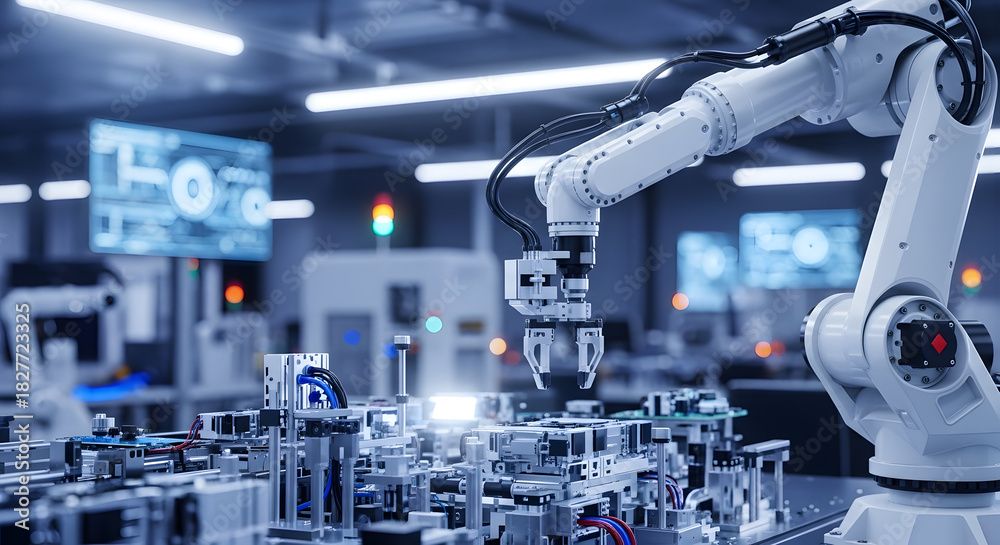
2. Robotics in Manufacturing
Industrial robots are used extensively in manufacturing for the repetition of work and the handling of hazardous situations.
- Welding robots
- Packaging robots
- Painting robots
Additionally, robots help in minimizing errors, and at the same time, they increase the safety of the workers and the quality of the product.
3. Computer-Aided Manufacturing (CAM)
Computer-aided manufacturing refers to the use of software to direct the operation of machinery.
- CNC (Computer Numerical Control) machines
- CAD/CAM systems
- Tools for precision machining
As a result, manufacturing is done with very high precision and very little waste.
4. Additive Manufacturing (3D Printing)
Additive manufacturing is a process that produces an object by adding material layer by layer.
- Fast prototyping
- Specific parts
- Heavier industrial pieces that are still strong
Thus, industries can save on materials and cut down the development time for new products.
5. Smart Manufacturing and Industry 4.0
Smart manufacturing is the production that is fully equipped with digital technologies.
- IoT or Internet of Things
- Artificial Intelligence
- Data analytics
- Physical systems that are integrated with computers and sensors
Consequently, the plants turn into more adaptable, productive, and smart ones.
The Impact of IT on Manufacturing
IT provides the infrastructure for real-time monitoring and decision-making.
- ERP or Enterprise Resource Planning
- Supply chain management software
- Quality control systems
Moreover, IT enhances interdepartmental communication and cuts down downtime.
Industrial & Manufacturing Technology Importance
Industrial and manufacturing technology necessity can be seen through its effects in:
- Economic development
- Large-scale production of items
- Jobs creation
- Innovation and competitiveness
No advanced manufacturing systems, modern economies are unable to run efficiently.
Industrial & Manufacturing Technology Merits
- Faster production rate
- Higher quality product
- Lowered labor costs
- Safer work environment
- More effective resources utilization
- Difficulties and Limitations
The technology does face some challenges, despite being a blessing:
- Hefty initial capital outlay
- Requirement of skilled people
- Cybersecurity threats
- Compliance with environmental laws
Thus, manufacturers must keep a check on the co-relation between technology and sustainability, along with the workforce grooming.
The advancement of Industrial & Manufacturing Technology
The main vision of the future is sustainability, automation, and intelligence.
- Nature friendly production
- Robots operating without human intervention
- Virtual replicas of physical assets
- Interplay between humans and machines
Which means that the field will be more productive, less pollutant, and more flexible.
Final Remarks
To sum up, the technology for industrial and manufacturing has changed the method of goods’ production completely. The development has been from basic mechanical devices to smart factories that are able to learn and adapt. If the technology is applied with care, it will not only be a booster for economic growth but also a source of industrial innovation in the future.